FragDenStaat-Animation
'Frag den Staat' is a vector animation video for Freedom of Information websites like https://fragdenstaat.de, made with Synfig Studio (synfig.org) and Inkscape (inkscape.org). Original video: http://cameralibre.cc/fragdenstaat Licensed under CC-BY.
Summary
| Latest Version | Unknown |
|---|---|
| License | Unknown |
| CI Status | Failing |
| Stars | 4 |
| Forks | 2 |
| Open Issues | 0 |
| Last Commit | 2017-03-17 |
| Downloads | 0 |
| Last Indexed | 2026-09-06 06:05 |
Tags
Installation
nimble install FragDenStaat-Animation
choosenim install FragDenStaat-Animation
git clone https://gitlab.com/cameralibre/FragDenStaat-Animation
OS Compatibility
| Platform | Linux | macOS | Windows | FreeBSD | OpenBSD | NetBSD | Android | iOS | WASM | Embedded |
|---|---|---|---|---|---|---|---|---|---|---|
| FragDenStaat-Animation | ✓ | ✓ | ✓ | - | - | - | - | - | - | - |
Source
| Repository | https://gitlab.com/cameralibre/FragDenStaat-Animation |
|---|---|
| Homepage | https://gitlab.com/cameralibre/FragDenStaat-Animation |
| Registry Source | gitlab |
README
About
'Freedom of Information & Frag den Staat' is a vector animation created using the Free Software tools Synfig Studio and Inkscape.
You can see the original video in its entirety at Camera Libre.
I made the original in 2014 - I've since released and documented the project files to allow other people in other countries to use and adapt the video.
This is the first prototype of a larger project - Open Source Animation for Activism, Education, and Civic Organisations - see the intro video here:
'Freedom of Information & Frag den Staat' is designed to explain and promote the German Freedom of Information website Frag den Staat ("Ask the State") as well as the idea of Freedom of Information more generally.
Frag den Staat was set up by Stefan Wehrmeyer and Open Knowledge Foundation Deutschland, and since 2015 has been led by Arne Semsrott.
Stefan also created FROIDE, the software which FdS is built on.
FROIDE and the similar software project Alaveteli are the basis of a number of FOI websites around the world, who share a common goal, and a common approach: to strengthen transparency and democracy, by enabling citizens to exercise their right to information about public bodies.
Hopefully this animation can be adapted and improved to serve their purposes.
Original (German) version of scene 3:
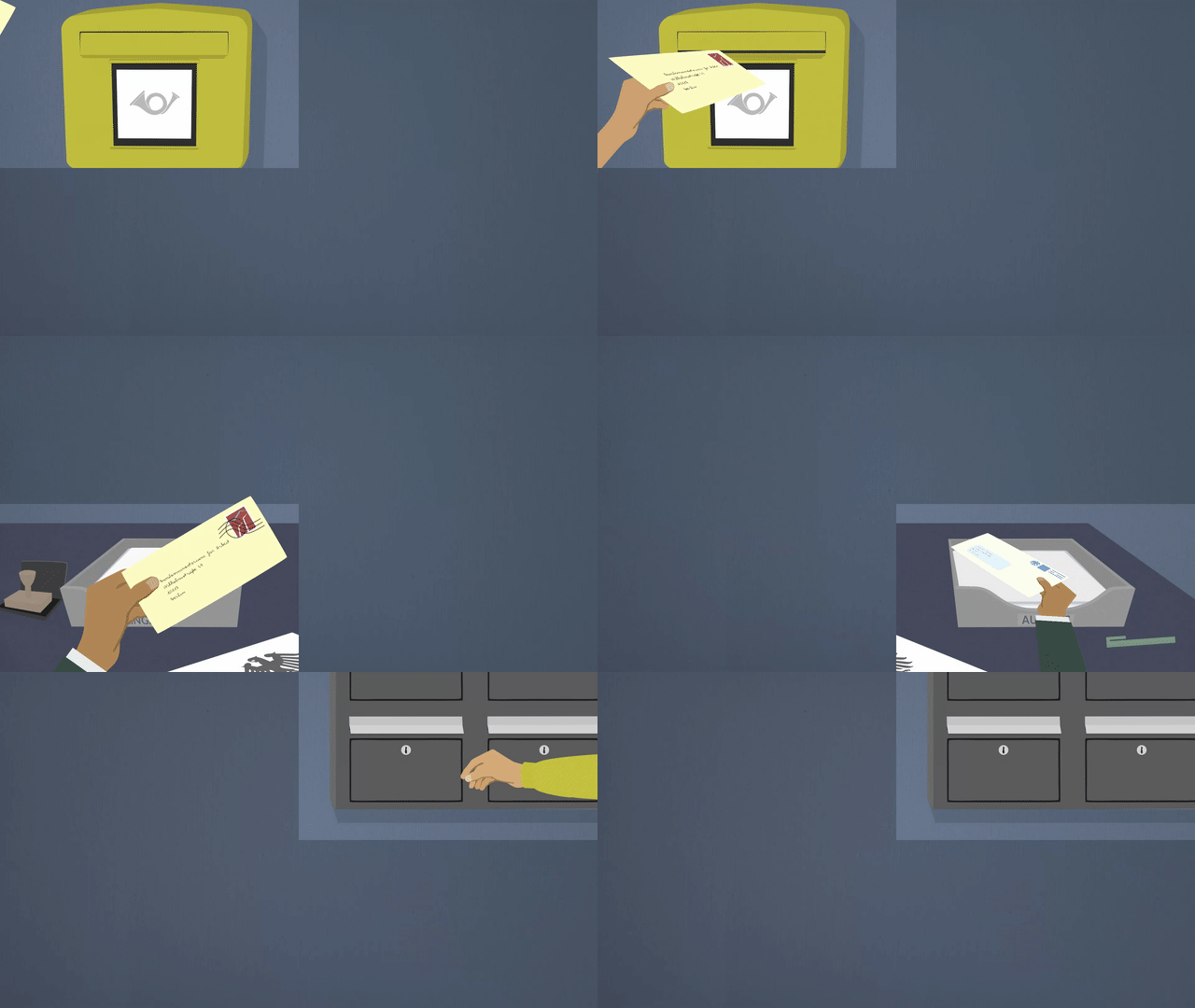
Adapted (British) version of scene 3:

A Hungarian version has been animated for the site Ki Mit Tud, which will be published in the coming days, once sound mix and feedback rounds have been completed.

Goals of this project:
-
To develop a template for any FOI portal to quickly, easily and economically create their own explanation animation - tailored for their site, their culture and audience. Also to allow people to further update and improve their animation as time goes on.
-
To experiment and develop best practices for collaborative 2D animation using free software, and provide a practical example for open sourcing animation, as well as using free/libre open source tools to create animation.
-
To develop a more efficient and flexible workflow. Right now, the documentation and arrangement of the project is very much set up for a user working with Inkscape and Synfig Studio with a graphical user interface - ideally in the future it could be possible to use a command line or simple web app to replace specific text or other elements, automating changes which currently have to be made manually by clicking through the GUI. In addition, this may eventually be suited to flexible in-browser display using the Web Animations API rather than animating in Synfig and rendering to an inflexible, heavy video file. The technology (and my own abilities with it) have a way to go, however.
-
To improve the original video. There are a wide range of problems with the original which I would like to fix (in terms of timing, design, sound design as well as the general text and concept). However, animation is extremely time consuming and at some stage I simply had to say "OK, it's done" - I (literally) couldn't afford to keep tinkering. Through allowing others to take the project and improve it, or being commissioned to do so myself, I hope that changes and improvements can benefit all versions of the video. By reworking the animation for the hungarian version I've been able to improve a few key design and animation elements, as well as refactoring the projects to make it easier to adapt in the future.
Project Overview
The project is split into 12 Synfig projects - every time there is a hard scene cut, rather than an animated transition, I use a new project. This means that some scenes are very short (eg '06 document handover') whereas others are very long and complex ('02 inside government' and '10 laptop'). Scene 05 and scene 07 are actually contained within one project.
PROJECT LIST:

01 title

02 inside government - Hungarian version

03 post

04 document types - Hungarian version


05 07 protestors

06 document handover

08 multiple offices -Hungarian version

09 combining data

10 laptop - Hungarian version

11 end title
When you export PNG sequences from each of these projects into their respective folders in /png, you can then open the video editing project 'FragDenStaat.kdenlive' and combine them with a new voiceover. (You can use the Audacity project 'FragDenStaat_Mix.aup' to mix your voiceover with the existing sound effects.
Repository Structure
/fonts A large part of adapting the project for international use is replacing German-language text with the local language, and changing the design/branding to suit a different FOI website. Text visible in any scene can be easily changed by opening the .sif file in text editor and using its 'Find & Replace' function. However, differing word lengths may cause layour issues, so you will likely need to manually re-align text layers in Synfig.
/notes Here I've noted the elements in each scene which (probably) need to be changed to adapt the video to a different language or country, and created some basic documentation on the structure and concept of each particular scene.
/png The original Frag den Staat video included some bitmap files which were referenced in the animations, which was not ideal. These files have been removed or replaced with vector elements in the Hungarian (Ki Mit Tud) version of the video.
/script Voiceover script and concept for the entire video. It will need to be translated for international use and I would like to improve it along the way! This folder also includes subtitles in English, German and Chinese for the video. (Thanks Arne!)
/sif Synfig file format The main animation files are Synfig projects (.sif). There's one project for each scene in the video. Other than some linked texture files (removed in updated versions), the elements in the projects are all vector graphics, meaning they are simply mathematical expressions of points, lines, curves, shapes or polygons. This means that the projects are very flexible, lightweight*, and as the projects are text-based XML files, they lead themselves well to version control & scripting. To learn the basics of Synfig, I would recommend the official Synfig Studio Training Course.
/svg
Inkscape file format
The illustrations for this video were created in Inkscape - mostly by me, but with many contributions from Judith Carnaby.
Personally, I find Inkscape more flexible and intuitive for creating vector images than Synfig, so I create my images in Inkscape and then save a copy as a .sif:
(File>Save As... Synfig Animation *.sif)
/textures The original version of the video included a number of public domain texture images (.jpg), which are overlaid on objects in Synfig. A texture can be imported (File>Import...) and placed directly above the groups or layers that you want to apply texture to. The 'Blending Mode' of the texture layer should be set to Overlay, and the 'Amount' (opacity) to something low, like 0,10. The texture files are only linked to the Synfig project, not embedded within the project. These textures are not used in the Hungarian version of the video.
/webm Reference videos for each scene.
License
Frag den Staat is currently licensed under Creative Commons Attribution 4.0 International.
I'm not sure if this actually makes sense for project files, or just the cultural content - if a software license is more appropriate, please let me know!
FOI portals around the world:
(let me know if I've missed any)
Australia
Right To Know
https://www.righttoknow.org.au/
Austria
Frag Den Staat
https://fragdenstaat.at
Bosnia
Pravo Da Znam
http://www.pravodaznam.ba/
Brazil
Queremos Saber
http://queremossaber.org.br/
Canada
Je Veux Savoir (site is gone - perhaps the project is dead now?)
http://www.jeveuxsavoir.org/
Croatia
Imamo pravo znati
http://imamopravoznati.org/
Czech Republic
Info Pro Všechny
http://www.infoprovsechny.cz/
Europe
Ask the EU
http://www.asktheeu.org/
Germany
Frag Den Staat
https://fragdenstaat.de
Hong Kong
accessinfo.hk
https://accessinfo.hk/
Hungary
Ki Mit Tud
http://kimittud.atlatszo.hu/
Israel
Ask Data
http://askdata.org.il/
Italy
Diritto Di Sapere
https://chiedi.dirittodisapere.it/
Macedonia
Слободен пристап
http://www.slobodenpristap.mk/
New Zealand
FYI
https://fyi.org.nz/
Romania
Nu Vă Supărați
http://nuvasuparati.info/
Russian Federation РосОтвет http://rosotvet.ru/
Rwanda
Sobanukirwa
https://sobanukirwa.rw/
Serbia
Da Zanamo Svi
http://daznamosvi.rs/sr
South Africa Right2Know http://www.r2k.org.za/
Spain
Tu Derecho A Saber
http://tuderechoasaber.es/
Tu Derecho a Saber was shut down in December 2015 due to the government's refusal to respond to FOI requests submitted electronically!
Sweden Fråga Staten http://fragastaten.se/
Tunisia
Marsoum 41
http://www.marsoum41.org/en
Uganda Ask Your Government http://askyourgov.ug/
Ukraine
Доступ до правди
https://dostup.pravda.com.ua/
United Kingdom
WhatDoTheyKnow
https://www.whatdotheyknow.com/
United States iFOIA https://www.ifoia.org
Uruguay
Que Sabes
http://www.quesabes.org/